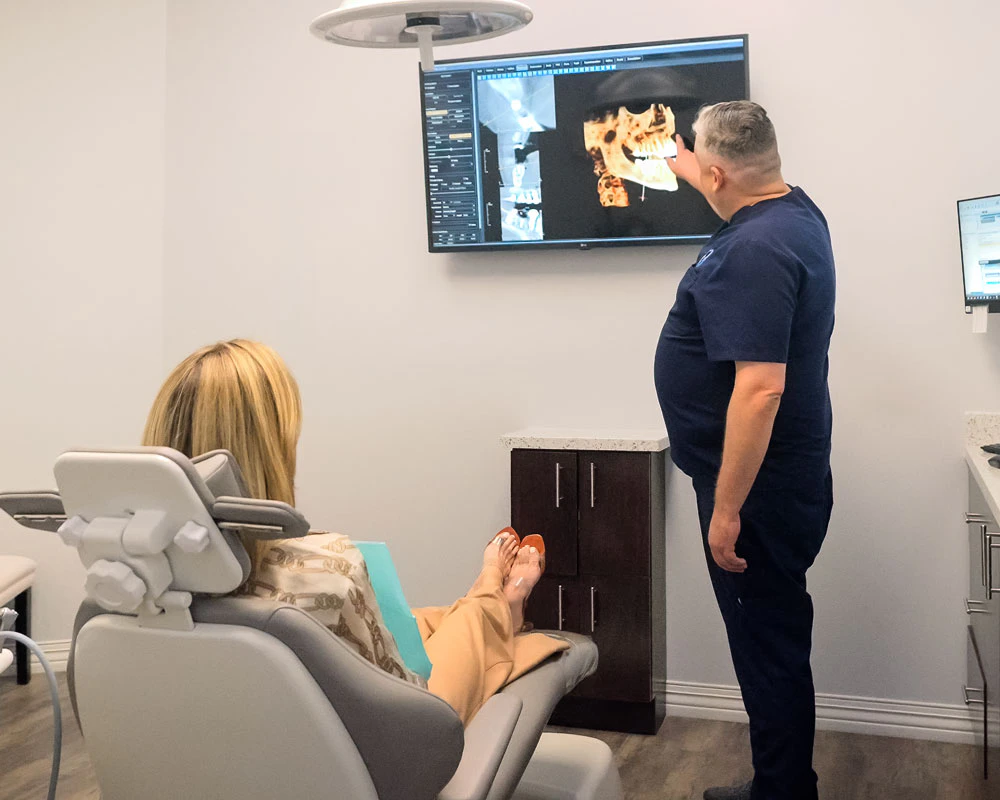
A Path to Faster Orthodontic Results
SFOT, also called accelerated orthodontics or corticotomy-facilitated orthodontics, is a surgical procedure that helps your teeth move faster during orthodontic treatment. The surgery itself takes one in-office visit, and the active orthodontic phase that follows is shorter than traditional orthodontics, often by months.
The procedure works by triggering the body's natural healing response in the bone surrounding the teeth being moved. This response, called the regional acceleratory phenomenon, temporarily speeds up bone turnover and lets teeth move two to three times faster than they would otherwise.
Some patients also benefit from a bone graft placed during the same visit (a protocol called PAOO, Periodontally Accelerated Osteogenic Orthodontics). The graft expands the bone around the teeth, which gives your orthodontist more room to work and reduces the risk of relapse after treatment ends.
Your cost will depend on the size of the treatment area, whether bone grafting is included, and the sedation plan you select with your treatment coordinator.
Dental insurance does not typically cover the SFOT procedure since it is paired with elective orthodontic treatment. Your treatment coordinator will explain the cost during your consultation, including financing through CareCredit® if you would like to spread the investment across a more manageable timeline.
Most patients see active orthodontic time reduced by 50 to 75 percent, often dropping a 24-month case to 6 to 12 months. The exact reduction depends on the complexity of your case and your orthodontist's plan.
The procedure is performed with sedation and local anesthesia, so you should not feel the surgery itself. Recovery is similar to a moderate dental surgery: some swelling and soreness for several days, managed with prescribed or recommended medication.
Yes. SFOT accelerates orthodontic movement regardless of whether your orthodontist is using traditional braces, clear aligners like Invisalign®, or another system.
SFOT, especially with bone grafting, often improves long-term stability by expanding the bone around the teeth. Standard retention is still required, but relapse risk is typically lower than with orthodontics alone in complex cases.
Most patients come to us already working with an orthodontist or planning to start. If you have not selected an orthodontist, your treatment coordinator can connect you with practices we coordinate with regularly near our Tampa, Land O' Lakes, Wesley Chapel, and Valrico offices.

Dr. Jason Edwards, Dr. Thomas Backeris, Dr. Jason Blundell and Dr. Pat Gaus use the latest techniques and have advanced training. They are members of various notable organizations, including:
To schedule your consultation at our state-of-the-art office, call us at (813) 452-6380.
Locations
We have 4 locations the greater Tampa area